Most of us leave home almost every day without giving much thought to how we will get back. We drive to work, church, the grocery store, a doctor’s appointment or to visit family. We know the roads. We have a vehicle. And if we’re somewhere unfamiliar, we have GPS on our phones to tell us exactly how to get home.
But what if, one day, those things weren’t available? What if you were 10, 20 or 30 miles from home and couldn’t simply get in your vehicle and drive back?
The reason could be relatively ordinary—a severe storm, flooding, a widespread power outage or roads that have suddenly become impassable. Or it could be part of a much larger emergency that results in the loss of normal transportation or communications, or makes travel unsafe.
The particular emergency isn’t really the point. The question is: Could you get home? And would you know what to do if you couldn’t?
A Plan Is More Than an Idea
In the last Preparedness Notebook entry, we talked about assessment as the first step in preparedness. This month, we’re going to put that assessment to work. Preparedness requires plans. Not one plan for every possible emergency—we could never anticipate every circumstance—but plans that give us a framework for making decisions when circumstances aren’t normal. And I believe those plans need to be written down.
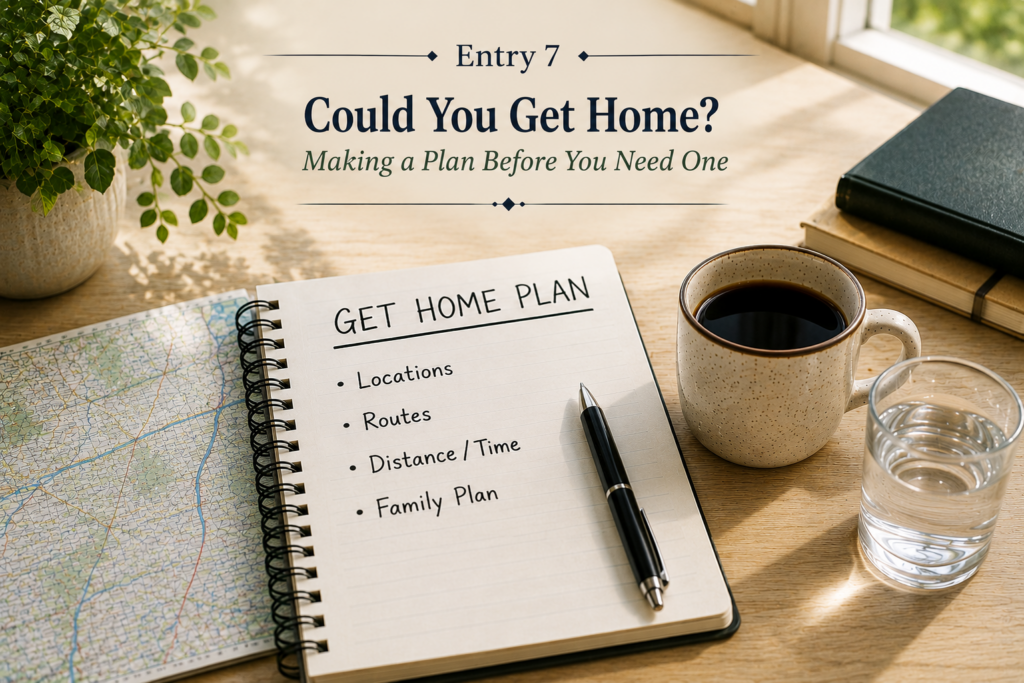
Thinking, I know approximately what I would do, isn’t the same as sitting down with a notebook and working through the details. Writing exposes the questions we haven’t answered. So pull out your preparedness notebook. We’re going to begin a Get Home Plan.
Step One: Where Are You Likely to Be?
Start with your real life. Write down the places where you and the members of your household routinely spend time away from home. That might include:
- Work
- School
- Church
- Grocery stores
- Medical appointments
- Family members’ homes
- Regular activities
- A nearby town or city you frequently visit
Beside each location, write down approximately how many miles it is from home. Don’t worry yet about how you would get home from each one. For now, we’re simply establishing the places where you are most likely to be and the distance between each of them and home. Once we have those starting points, we can begin looking at what getting home from each of them might actually involve.
Step Two: Do You Actually Know the Way Home?
We drive familiar roads so routinely that it’s easy to assume we know exactly where we are. But do we? Could you find your way home without GPS?
For your most frequently traveled locations, identify your normal route home and at least one alternate route. Then look more closely at what lies between you and home.
Are there rivers you must cross? Bridges? Interstates? Railroad tracks? Areas that could flood? Industrial districts or other areas that might be difficult or unsafe to travel through on foot? Are there portions of the route where you would feel comfortable driving through but would not want to walk through—particularly alone or after dark?
And here’s another question we don’t normally ask: Would the route you drive be the route you would choose if you had to walk?
Your normal driving route may not even be accessible on foot, and the safest walking route may be considerably longer than the mileage you normally drive. On the other hand, don’t automatically assume that smaller roads or side streets are the better choice. A major travel corridor may provide a more direct route, better visibility and more room to maintain your personal space. The important thing is to consider these options before you need them and identify more than one possible route home.
Write these things down. A paper map of your local area can become an important part of this exercise.
Step Three: Think in Time, Not Just Miles
Now consider what it would realistically take for you to travel that distance on foot. Not an experienced hiker. Not a healthy 25-year-old. You. Your age, health, physical condition, footwear and the terrain all matter. So do heat, cold, rain and darkness.
A distance that looks manageable on a map may become something very different if it requires most of a day—or more than one day—to travel. Knowing how long the journey might take isn’t meant to discourage you from making it. It’s meant to help you prepare for it.
If circumstances have made getting home the safest course of action, then home is the goal. There may be a real sense of urgency, but urgency doesn’t necessarily mean speed. Especially as we grow older, it may mean pacing ourselves, resting when necessary and continuing to move steadily toward home.
Don’t allow the number of miles—or the number of hours—to become a mental obstacle. Break the journey into manageable pieces and keep following the plan. The goal isn’t to get home quickly at the expense of your safety. The goal is to keep going until you get home safely.
For each of your important locations, write down a realistic estimate of how long you think it could take you to get home on foot. You aren’t trying to predict the future perfectly. You’re beginning to understand what the journey may require.
Step Four: Change One Thing
Now we’re going to do something that makes preparedness planning much easier. Instead of trying to imagine every disaster that could possibly occur, take your basic plan and change one circumstance at a time.
Work through the questions below one at a time. Read the first question, stop, think through what you would actually do, and write your answer in your preparedness notebook before moving to the next question. Don’t just read through the list. The purpose of this exercise is to begin making the decisions now that you don’t want to be making for the first time in an emergency.
What if my vehicle doesn’t work?
What if my normal road home is blocked?
What if GPS and cell service aren’t available?
What if it’s extremely hot?
What if it’s freezing or raining?
What if darkness comes before I can get home?
What if I can’t safely reach home today?
And perhaps most importantly: What if trying to get home is more dangerous than staying where I am?
When you’ve finished, look back over your answers. You haven’t tried to create a separate plan for every disaster that might happen. Instead, you’ve identified the circumstances that would change your decisions—and you’ve already begun deciding how you would respond.
This is the beginning of a workable plan.
Step Five: What Is Everyone Else Going to Do?
Now the plan becomes a family plan. Imagine that something happens at 2:00 on an ordinary afternoon. You’re at the grocery store. Your spouse is at work. A child or grandchild is somewhere else. Perhaps an elderly parent is home alone.
Now imagine that you cannot communicate with one another. That may be one of the most unsettling parts of an emergency because we have become accustomed to being able to reach the people we love almost instantly. But your family plan needs to consider the possibility that, for a period of time, you simply may not be able to.
What does everyone do if no one can reach anyone else? Does everyone attempt to get home? If home isn’t accessible, where is the secondary meeting place? Under what circumstances should someone stay where they are? Should anyone leave a safe location to search for another family member?
These aren’t decisions we want to make for the first time when we’re frightened and don’t know where the people we love are. Sit down together and decide. Then write those decisions in the notebook.
Your plan should also identify the ways you will try to communicate—calls, text messages, a landline or an agreed-upon contact person. An out-of-area contact can also be part of that plan. But don’t build your family plan around the assumption that any one of those methods will necessarily work.
There may be circumstances when none of those methods work. For a period of time, you may simply be unable to reach one another. That’s why the decisions you’ve made together ahead of time matter so much. If I can’t reach you, I already know what you’re going to try to do—and you know what I’m going to try to do.
The plan becomes a form of communication made in advance.
Put the Plan on Paper
Your written Get Home Plan doesn’t need to be complicated. It needs to contain the information your family would need if normal routines and communications weren’t available: Your important locations. Distances. Primary and alternate routes. Meeting places. Family phone numbers. Contact information for the people you’ve designated as part of your communication plan. Important addresses. Decisions you’ve already made about when to travel, when to stay put and where to meet.
And don’t let your phone be the only place that information exists.
Once you’ve completed the plan in your preparedness notebook, make copies of the information family members may need when they’re away from home. Keep a copy in each vehicle. If you have children, consider placing a copy securely in each child’s backpack or school bag as well.
Think carefully about what information those copies need to contain. They should provide the important phone numbers, addresses, meeting locations and basic instructions a family member would need without unnecessarily including sensitive personal information.
The master plan stays in your preparedness notebook. But the essential parts of that plan need to be where your family members are when they need them.
FEMA recommends much the same approach: families should decide ahead of time how they will contact one another, establish meeting places and an out-of-town contact, and make copies of their emergency communication plan for family members to carry in a wallet, purse or backpack.
FEMA also provides a printable Family Emergency Communication Plan card that family members can complete and carry with them: FEMA Family Emergency Communication Plan Card
A Plan Needs to Be Practiced
Writing the plan puts you miles ahead of where you were before—but don’t close the notebook and forget about it. Review the plan together as a family on a regular basis. Walk through the scenarios again. Ask the questions. Make sure everyone remembers the meeting places, knows what he or she is expected to do and understands what happens if you cannot communicate.
This is especially important with children. The purpose isn’t to frighten them with everything that could go wrong. It’s just the opposite. Calm repetition makes the plan familiar. If something does happen, they aren’t hearing the instructions for the first time while everyone is already under stress.
Circumstances change, too. Children grow older. Jobs and schools change. Family members move. Roads close and new ones open. Physical abilities change. Your plan needs to change with them. A plan we’ve practiced is much easier to follow than a plan we merely wrote down.
Your Assignment This Month
Don’t try to solve everything at once. Choose one place you regularly go. Write it at the top of a page in your preparedness notebook. Record the distance home. Find your normal route and an alternate route. Look for obstacles. Estimate how long it would realistically take you to walk home. Then work through the questions above.
When you’ve finished that location, choose another. You may discover that you already have a pretty good plan. You may also discover things you’ve simply never thought about. Either way, you’ve accomplished something important.
A plan doesn’t eliminate uncertainty. It keeps us from having to figure out everything for the first time in the middle of an emergency.
And once we know what our plan requires, we can ask the next question: What resources would we need to carry it out? That’s where we’ll go next month—building a simple Get Home Bag and a larger collection of vehicle resources designed around the plan we’ve just made.