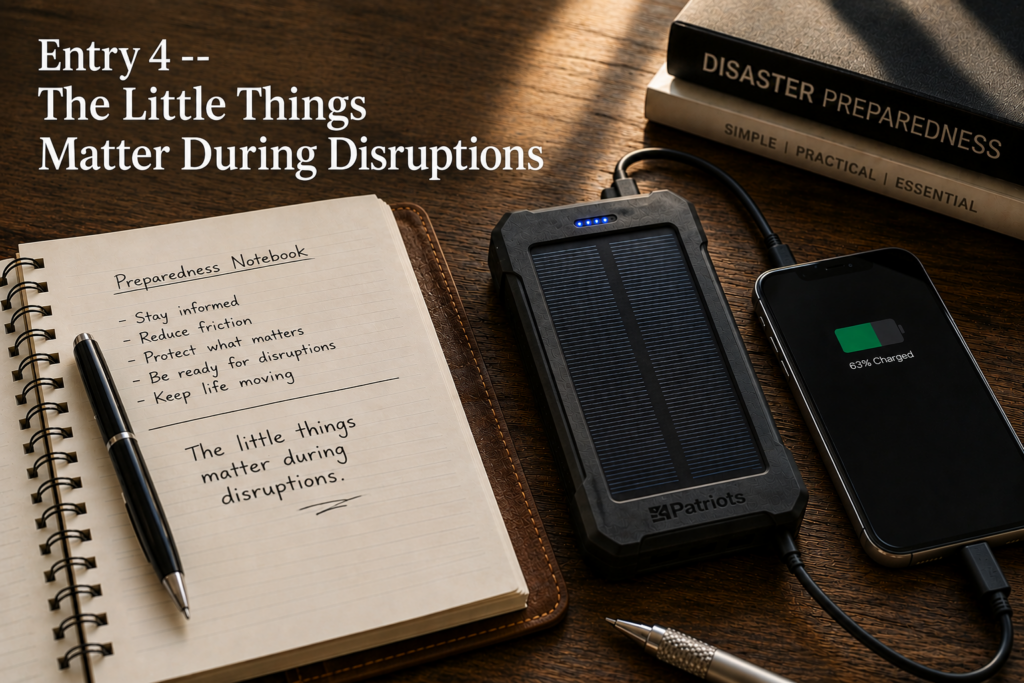
Preparedness is not simply about surviving difficulty. It is about reducing avoidable stress so we can continue functioning with greater calm and clarity when routines are disrupted.
We Rarely Notice Our Dependence on Power
Most of us move through daily life without thinking much about electricity. It quietly supports hundreds of ordinary tasks we depend upon every day.
Phones now function as maps, communication devices, flashlights, payment systems, weather alerts, and information hubs — all dependent upon battery power we rarely think about until it disappears.
Modern life depends upon electricity in countless small ways we rarely notice until those systems suddenly become unavailable.
Most disruptions do not arrive dramatically. More often, they begin quietly: a storm rolls through, the power goes out, a flight is delayed, or a vehicle breaks down.
And when those interruptions happen, it is often the little things that create the greatest stress.
Small Problems Become Mental Friction
A dead phone during an ordinary afternoon is annoying. A dead phone during a storm, airport delay, vehicle breakdown, or outage feels very different.
Suddenly communication, maps, weather updates, payment systems, and important information may all become harder to access.
Small inconveniences quickly become mental and emotional friction during stressful situations.
Under stress, small complications begin consuming attention and emotional energy that could be used elsewhere.
Preparedness helps reduce those avoidable complications before they become larger sources of stress.
The Portable Charger We Actually Use
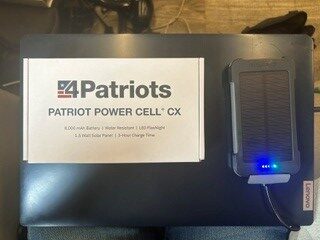
One of the simplest preparedness tools we have adopted over the years is the Patriot Power Cell™ CX from 4Patriots.com.
It is a small rechargeable battery bank about the size of a large phone, and it has quietly become one of the most consistently useful preparedness items we own.
We keep one in each of our get-home bags in the vehicles. When traveling by air, one goes into a carry-on bag or briefcase. If we expect to be away from outlets for longer periods of time, one often rides in a purse, backpack, or jacket pocket.
Most of the time, we use it during ordinary life — long travel days, airport delays, outdoor events, or anytime we expect to be away from outlets for extended periods.
The most useful preparedness tools are often the ones that integrate naturally into everyday life.
What We Like About It
- About the size of a large smartphone
- Easy to carry in bags, vehicles, or travel gear
- USB rechargeable
- Supplemental solar charging capability
- Useful during travel, outages, and long days away from outlets
- Helps maintain communication and access to information during interruptions
Why the Solar Feature Matters
We primarily recharge the Patriot Power Cell™ CX through a standard USB connection so it stays fully charged and ready to use. But the added solar capability creates another useful layer of flexibility.
While traveling or spending long periods away from outlets, the unit can simply be exposed to sunlight while in use or resting nearby. The solar panel is not intended to fully replace conventional charging, but it can help maintain or gradually recover charge during the day.
The solar feature is less about unlimited off-grid power and more about extending capability when outlets are unavailable.
Even partial charge can preserve communication, information access, and stability during disruptions.
The goal is not perfection. The goal is continuity.
Preparedness Is About Preserving Capability
Preparedness often works best in layers. Large systems certainly have their place. But disruptions are often experienced through small problems accumulating all at once.
A flashlight with dead batteries.
A missing prescription refill.
An empty pantry.
A phone that cannot recharge.
Lost access to information.
No backup plan when routines suddenly change.
Each issue alone may seem manageable. Together, they create stress, distraction, and fatigue.
Preparedness helps preserve decision-making capacity by reducing avoidable mental and emotional friction during unstable situations.
That principle extends far beyond portable chargers. It applies to preserved food, extra medications, stored water, emergency lighting, paper maps, first-aid supplies, cash reserves, personal safety tools, and countless other small layers of readiness that help life continue functioning when systems become unstable.
Preparedness is not fear.
It is the thoughtful reduction of avoidable stress so we can respond to disruption with greater calm, clarity, and capability.